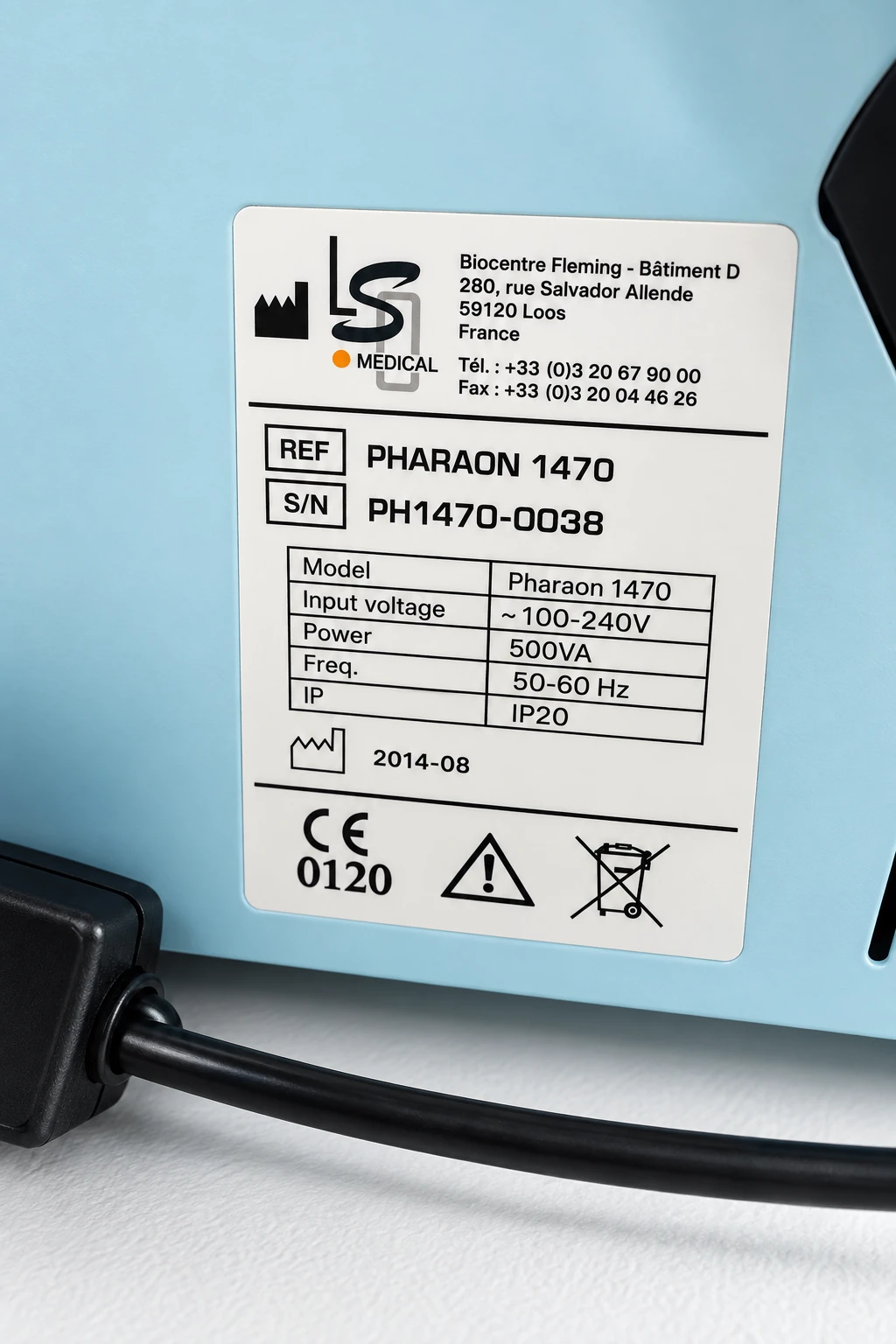
The story starts with the nameplate, not the screen
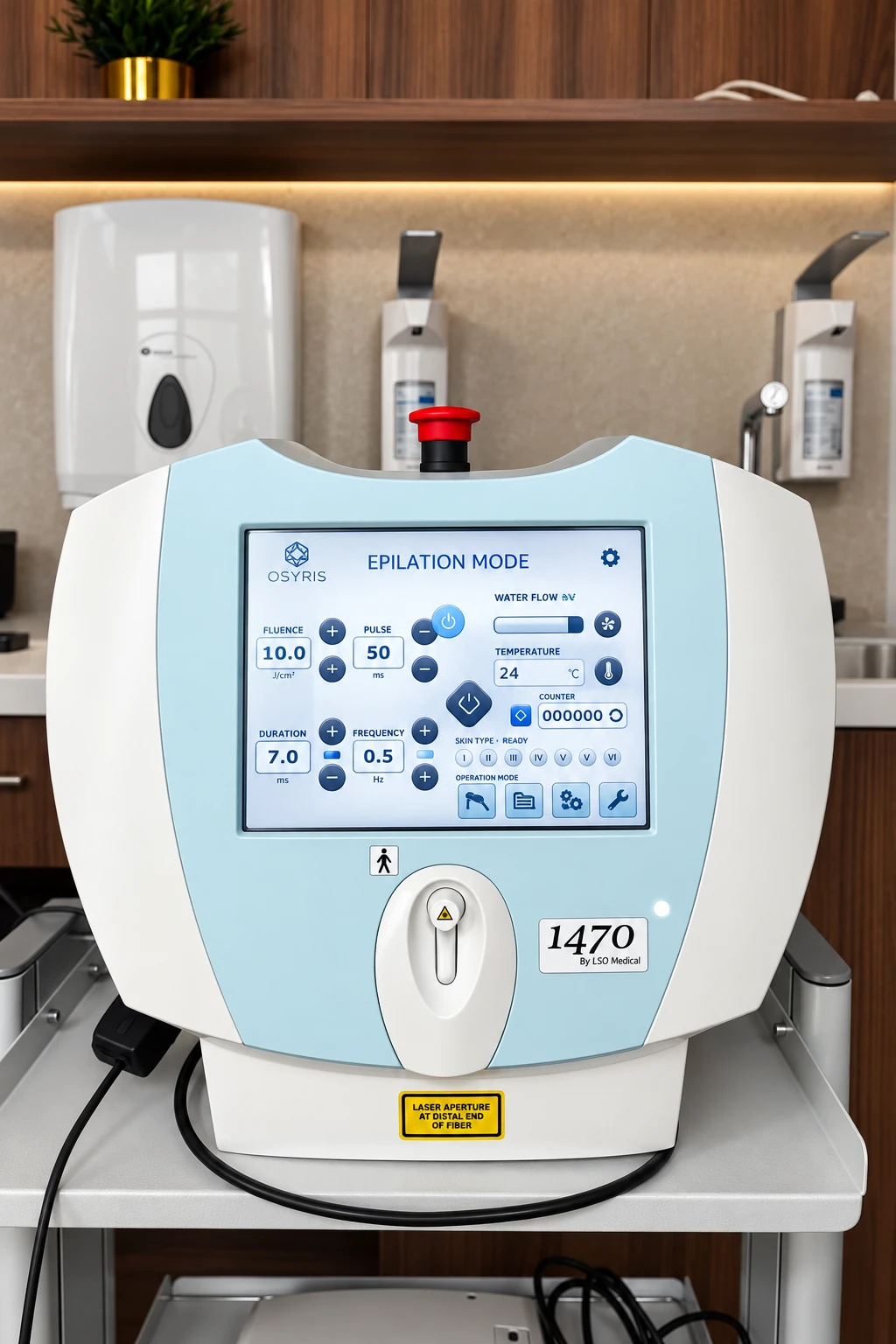
Pharaon 1470 is a medical laser platform from the LSO Medical family. The unit photographed at Denica clinic has PHARAON 1470, manufacturer LSO Medical and date 2014-08 on its nameplate. This confirms the age of that particular unit, not the model’s launch date. OSYRIS appears on the screen — a clue worth placing within this device family’s history.
LSO Medical describes its history as a French company founded in 2002 and associated with the Lille region. It specialised in lasers for treating vascular conditions. This provides manufacturer context; the photograph alone does not establish which procedures were performed with this unit.
OSYRIS, Pharaon and Endotherme: three names, specific sources
The 2008 FDA document K080731 names OSYRIS as the applicant for PHARAON 980 ENDO & EXO. It therefore confirms a historical connection between OSYRIS and Pharaon. However, it concerns the 980 version; it is not clearance for the photographed Pharaon 1470 or evidence of its full application range.
The manufacturer states that Endotherme 1470 entered the market in 2012. In its current product table, Endotherme 1470 has the reference PHARAON 1470 and is described as a 1470 nm diode laser. This directly connects the names. It does not mean every specification of today’s version can be assigned to a 2014 device without checking its instructions.
This gives a cautious but useful chronology: the earlier Pharaon family is documented in 2008, Endotherme 1470 appears in the manufacturer’s history in 2012, and our unit dates from August 2014. There is no need to invent additional equipment “generations”.
What does 1470 nm mean?
It is a wavelength, not device power. 1470 nanometres, or 1.47 micrometres, lies in the infrared. Two platforms with this wavelength may differ in power, energy delivery, fibre and intended use.
Water in tissue is an important absorber in this spectral region. Absorbed energy becomes heat. Where and how energy is delivered therefore matters alongside the laser type. The effects of 1470 nm and the fibre’s role are discussed, for example, in Hirokawa and Kurihara’s study comparing two fibre types.
Where has the technology been used in medicine?
Endovenous laser ablation, or EVLA, is a well-documented example. Energy is delivered through a fibre inside an incompetent vein, using heat to close it. The manufacturer describes Endotherme 1470 as a platform for thermal ablation of the great and small saphenous veins. This is an application of a particular platform, not a list of all possible uses of any 1470 nm laser.
The technology was already being studied in the late 2000s. A 2009 publication by Pannier, Rabe and Maurins reported one-year results using the Ceralas E 1470 nm diode laser. It studied a different device and must not be presented as a Pharaon 1470 study.
What changed with wavelength — and why does the fibre matter?
A randomised study published in 2015 compared a 1470 nm system with a radial 2ring fibre against a 980 nm system with a bare-tip fibre. Both groups had similar vein closure results at 12 weeks; the 1470 nm group had less pain and bruising.
Interpretation matters: both wavelength and fibre changed. The entire difference cannot be attributed to 1470 alone. The study concerned specific configurations of other devices, not a promised treatment outcome for every device bearing this number. Indications for a particular model and version are defined in its manufacturer’s documentation.
An older device needs its own history
A nameplate date does not replace technical assessment. Professional equipment can remain in use for many years if condition, support and documentation requirements permit. Equally, a working screen does not describe every component’s condition.
Regular diagnostics, cleaning and work records therefore matter. Age is one factor in maintenance planning alongside operating conditions and usage intensity. We also discuss the value of documentation in our article on equipment with a service history.
A practical example is the Pharaon 1470 maintenance visit at Denica clinic in Wrocław: diagnostics, internal cleaning, full scheduled maintenance, post-work checks and documentation. That visit is described separately. Our support is detailed on the laser equipment servicing page.
View the Pharaon 1470 maintenance case
Diagnostics, maintenance and device documentation at Denica clinic.