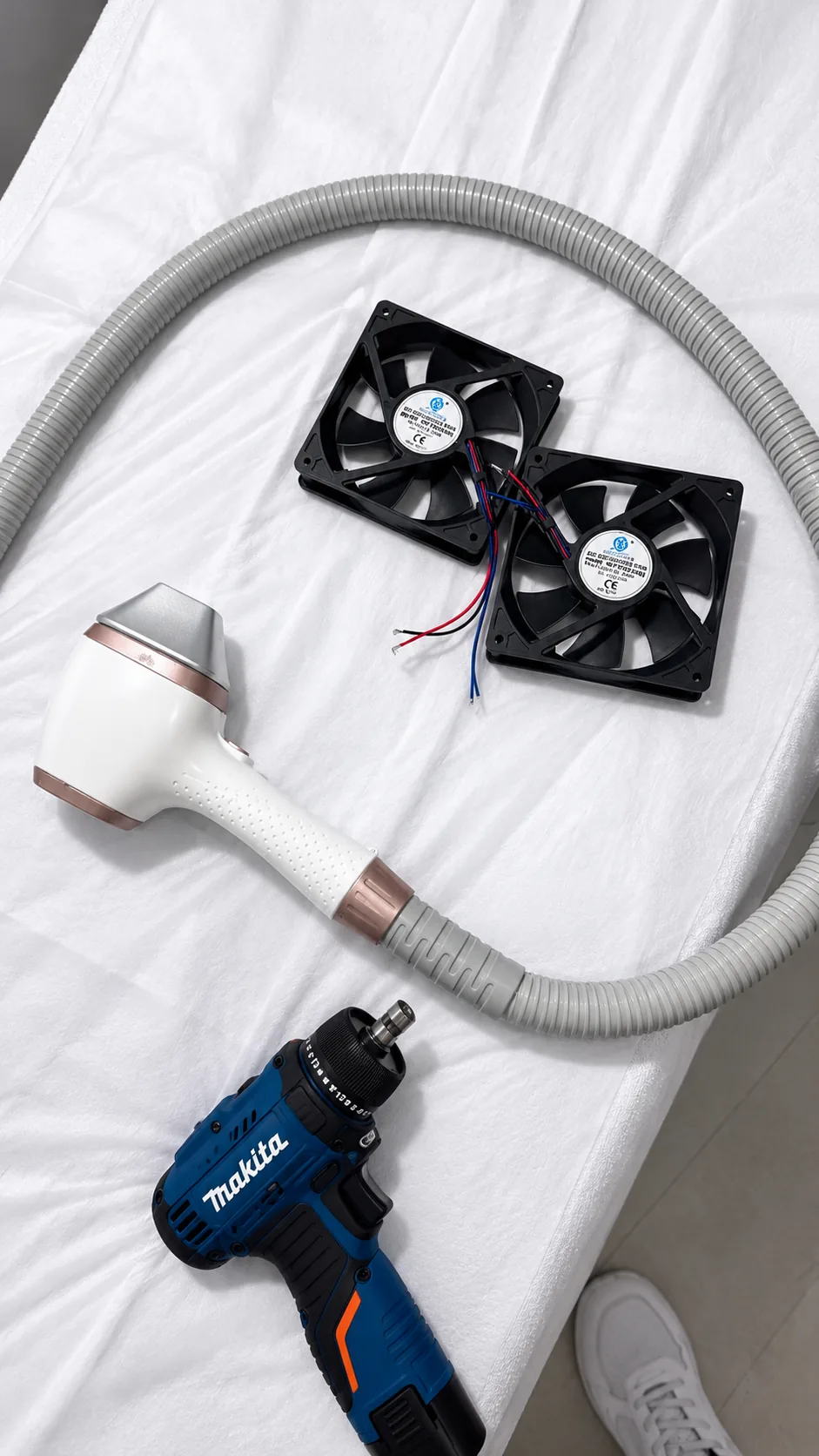
What does the system cool, and why does temperature matter?
Not all the energy drawn by a device becomes useful radiation. Some is released as heat in electronics, power supplies and other components. The cooling system removes this heat so that components operate within the temperatures specified by the manufacturer. There is no single cooling arrangement suitable for every laser.
Depending on the design, fans ventilate internal compartments, direct air through electronic heat sinks or cool a liquid circuit’s heat exchanger. A heat sink increases the surface area available for heat dissipation, but needs an unobstructed airflow path. In a liquid-cooled device, the pump circulates fluid that carries heat to the exchanger, and airflow may be needed to transfer that heat into the room. A working liquid circuit does not automatically compensate for a blocked air side.
Diagnostics should therefore cover the entire heat dissipation path, not merely whether a fan rotates. Device design, required wall clearances and the ambient conditions specified in the instructions all need consideration.
How does dust restrict airflow and heat dissipation?
Air carries dust and fibres that collect on grilles, filters, blades and internal surfaces. Dirty passages have a smaller effective cross-section, while deposits between heat sink fins obstruct airflow. Aerodynamic resistance increases: a greater pressure difference is needed to move air through the path.
A layer of contamination can also impede heat exchange between a surface and the air. The fan still rotates, but less air passes over the cooled component, or air bypasses it along an easier route. Visible rotor movement does not confirm adequate cooling. Increasing speed or replacing a fan alone does not remove a blockage.
Uneven deposits on blades can unbalance the rotor. Vibration puts additional strain on mountings and bearings. If contamination reaches the bearings, its effect depends on their type and sealing. Increased duct resistance should not automatically be equated with increased motor current: the electrical and mechanical response depends on fan design and control.
Why do fans fail?
Possible causes include bearing wear, contamination, rotor imbalance, blade rubbing, damaged mountings and faults in wiring, connectors or motor electronics. Prolonged operation at elevated temperatures can impair lubrication and component life. Temperature effects also depend on bearing type and permitted operating conditions.
Unusual noise may therefore indicate a mechanical problem, but does not establish a diagnosis on its own. A fan that does not start need not have a failed motor — its supply or control may also require checking. Dust is an important risk factor, but not always the only cause.
Fan selection: similar dimensions do not mean compatibility
A replacement fan must match the device requirements and component documentation. Electrical compatibility and appropriate performance characteristics are needed alongside mechanical fit. Higher speed or a large figure on the label alone does not establish better cooling.
Power supply, mounting and airflow direction
- Rated voltage and supply range: must match the device’s output. Excessive voltage can damage motor electronics; insufficient voltage may prevent start-up or correct operation.
- Current draw: the supply and controller’s permitted load and start-up requirements must be considered. A replacement must not overload the circuit.
- Overall and mounting dimensions: width, height, thickness, hole spacing and wiring clearance all matter. Even a similar frame may not fit the mounting.
- Airflow direction: must follow the designed air path. Reversing it can disrupt compartment or heat exchanger cooling.
Flow, pressure and the actual operating point
CFM means cubic feet per minute, while m³/h means cubic metres per hour. Both describe volumetric airflow. Static pressure, usually given in Pa or mmH₂O, helps describe a fan’s ability to overcome duct resistance. Catalogue maximum flow and maximum pressure do not occur simultaneously under the same conditions.
A fan with a high CFM rating does not necessarily cool better in a system with high aerodynamic resistance. What matters is the flow achieved against the actual air path’s resistance, not just the catalogue maximum.
Assessment uses the fan’s pressure–flow curve and the system resistance curve. Their intersection determines the operating point. Selection based solely on CFM can therefore produce an unsuitable replacement. Contamination changes air path conditions, so system clearance must be considered before assessing fan suitability. This is a general engineering principle, not a claim that measurements were taken on the repaired device described below.
Speed, bearings and noise
RPM means revolutions per minute. It does not describe airflow on its own: blade geometry and system resistance also matter. Bearing type should suit the temperature, mounting orientation and required service life. Noise matters in a clinic, but a quieter fan cannot replace a part with the required performance solely for acoustic comfort.
Connector, pinout, tachometer and PWM
The same connector or number of wires does not guarantee the same pin assignment. Each pin’s function and signal requirements must be checked. Incorrect supply connections can damage the fan or control circuit. Identification must not rely solely on wire colours.
Where a tachometer is provided, its signal informs the controller of rotational speed. PWM, or pulse-width modulation, may be used to control speed. Not every fan has these functions, and signal levels are not universally identical. Absence of a required monitoring signal can trigger a fault message or stop operation even when the rotor is turning. These requirements are checked in documentation, not by trying random connections.
Which symptoms indicate a cooling problem?
Depending on the device, symptoms may include new noise, rubbing or vibration, reduced heat dissipation, temperature warnings, unstable operation, automatic shutdown or overheating of individual components. Models differ in their sensors and protection systems. Some problems cannot be seen without service access.
Symptoms must be assessed against the instructions and the device’s previous behaviour. An alarm or repeated shutdown calls for stopping operation in accordance with the instructions and arranging diagnostics. Bypassing protection or repeatedly restarting an overheating device is not a repair method.
Why can preventive maintenance reduce failure costs?
Inspection and cleaning help identify deteriorating operating conditions before more serious damage develops. Neglect can lead to premature component wear, electronics failure or damage to other heat-sensitive assemblies. Repair may then require more than fan replacement.
Economic consequences include device downtime, scheduling changes and cancelled treatments. There is no universal saving or guarantee that servicing prevents every failure. The benefit is reduced risk and more predictable operation, not a promised percentage reduction in costs.
How should cleaning intervals and safe work limits be determined?
The starting point is the manufacturer’s guidance for the particular model. Usage intensity, room dust levels, filter and duct design, and conditions found during inspections must then be considered. Similar devices in different environments may need different inspection schedules. A universal interval should not be assumed.
Users should perform only tasks permitted by the instructions, such as checking external inlets and required clearances. Internal cleaning and electrical checks should be carried out by a qualified specialist. Unplugging the device does not automatically remove energy stored in charge-holding components. Isolation, protection and safe-access procedures must follow the service documentation.
Record the date and scope of maintenance and any observed symptoms. Afterwards, operation must be checked in accordance with the device’s design. We do not recommend removing covers yourself, indiscriminately blowing air over electronics or installing parts selected only from a photograph.
Practical example: cooling repair in Wrocław
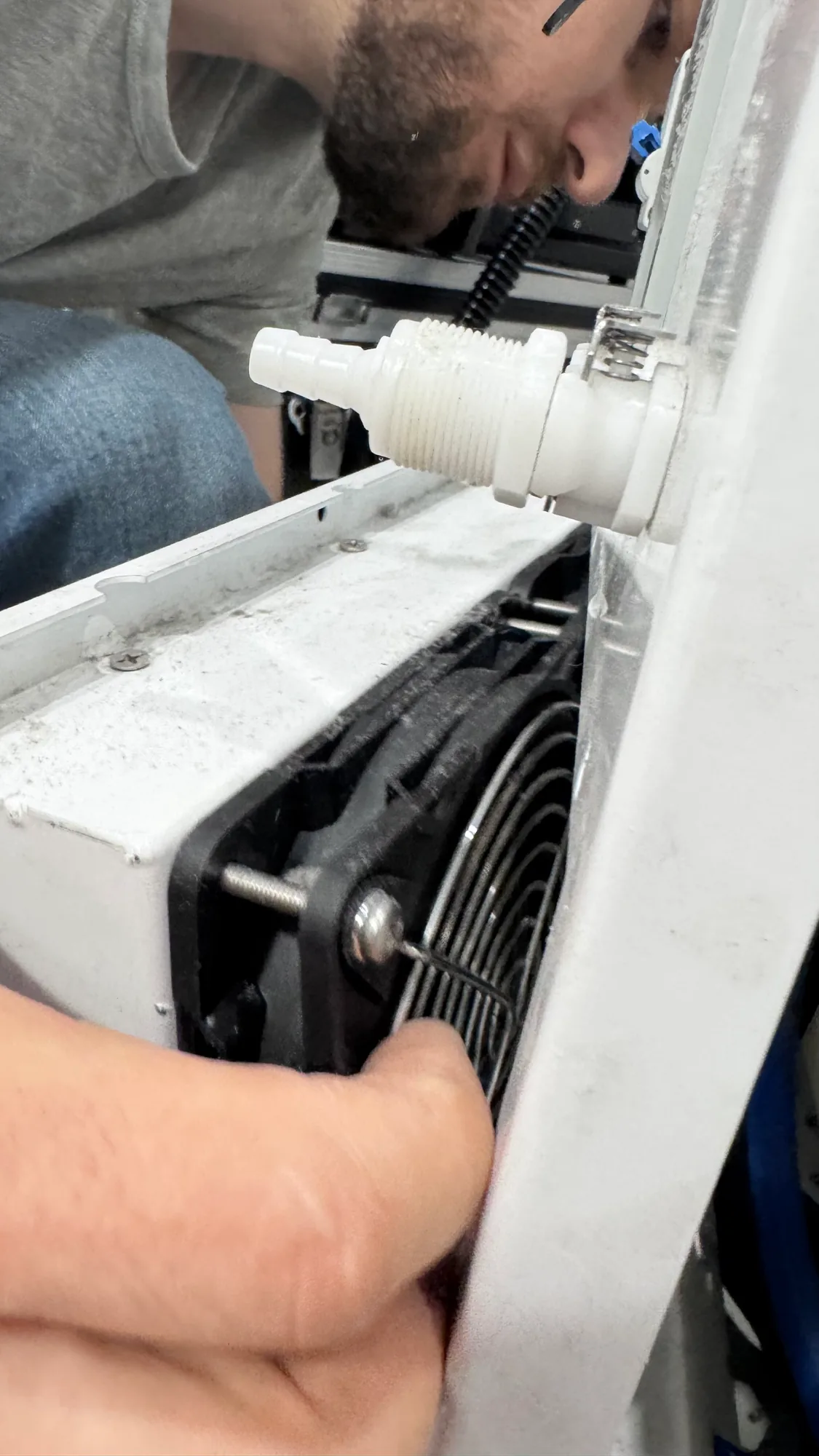
During a Laser Tech Service visit to a client in Wrocław, an aesthetic device had inadequate cooling. Diagnostics identified faulty fans and substantial internal contamination. The specialist replaced the fans, cleaned the internal components and checked cooling operation. The system’s function was restored and the device operates correctly.
These are the facts of this particular job. Component specifications, airflow measurements and temperature reduction figures are unconfirmed. Photographs and the work sequence are available in the laser cooling fan replacement case study from Wrocław.
Frequently asked questions
Why does a laser device overheat?
Possible causes include an obstructed air path, a damaged fan, unsuitable room ventilation or a liquid circuit fault where such a circuit is fitted. Incorrect sensor readings are also possible. A temperature warning is a symptom requiring diagnostics, not confirmation of one particular failure.
Can dust damage a fan?
It can contribute to damage: blade deposits may cause uneven loading and vibration, while contamination reaching a bearing may accelerate wear. This depends on design and sealing. Normal wear and electrical faults must also be ruled out.
Can any fan of the same size be installed?
No. Supply requirements, permitted current draw, pressure–flow characteristics, airflow direction and electrical connections must also match. If the controller requires speed feedback or PWM, the replacement must support the correct signal standard.
Why does the device still overheat when the fan is running?
A rotating rotor does not prove sufficient airflow through the heat sink. Blocked filters, a contaminated exchanger, incorrect airflow direction or leaks allowing air to bypass the heat sink can restrict cooling. In liquid-cooled devices, the pump, circulation or heat exchange may also be responsible.
How often should the cooling system be cleaned?
Start with the manufacturer’s schedule. Intensive use, high dust levels and specific system design may require earlier inspection. Determine timing for the individual device using its documentation, operating conditions and inspection findings.
Can faulty cooling damage other laser components?
Yes. Prolonged operation outside permitted temperatures can shorten the life of electronics and power components. Thermal protection, where fitted, reduces risk but does not replace effective cooling. Follow the instructions and arrange diagnostics if alarms or automatic shutdowns occur.
Technical sources and further reading
Component manufacturer Same Sky explains general airflow and pressure principles, bearing selection and control signals. These materials provide engineering background but do not establish the device model or component specifications in the Wrocław repair.
- Same Sky: Understanding Airflow Fundamentals for Proper DC Fan Selection
- Same Sky: Fan Bearing Types — Weighing the Pros and Cons
- Same Sky: Cooling Fans — Monitoring, Control & Protection
Our diagnostics and repairs are described on the laser equipment servicing page. Scheduled maintenance is discussed in the article on diode laser maintenance. For liquid-cooled devices, see the article on water in laser cooling systems; its recommendations apply only to the relevant design.
Need an assessment of your cooling system?
Provide the model, symptoms and service history. This helps establish the appropriate scope of diagnostics.
Laser equipment diagnostics, repairs and maintenance