Why does a laser need cooling?
Laser diodes convert some supplied energy into light and some into heat. Cooling removes that heat and helps maintain the conditions intended by the design. It is not merely an operator convenience.
In a liquid-cooled system, fluid properties and flow matter. Coherent explains the importance of laser diode cooling and how water requirements depend on module design. There is no single recipe suitable for every laser.
What changes in the water during use?
Fluid does not automatically remain clean because the reservoir is closed. Contamination may enter during maintenance or originate from system components. Dissolved substances can change electrical conductivity, while unsuitable water can encourage mineral deposits.
Depending on materials, fluid composition and operating conditions, corrosion or biological contamination may occur. Deposits and dirt can restrict flow or impair heat exchange. These are possible mechanisms, not findings in every device.
Clear fluid does not confirm every required property. Discolouration, cloudiness or visible deposits call for assessment according to documentation, not addition of an arbitrary cleaning agent.
Why should ordinary tap water not be used?
Tap water contains dissolved mineral salts and varies in composition. It may not meet a system’s purity and conductivity requirements. Deposits can impede flow and heat removal, particularly in narrow passages.
Use only fluid specified by the manufacturer for the particular model. Do not independently substitute distilled water for deionised water or vice versa, or add automotive coolant, biocide or other additives. For example, the Coherent Monaco manual sets its own cooling circuit requirements. These are not instructions for the device described here or universal guidance for hair removal lasers.
How does inadequate cooling affect the laser source?
Excessive temperature can impair diode efficiency and stability and shorten service life. Depending on the device, disturbed flow or excessive temperature may also trigger an alarm and stop operation. Do not bypass protection or dismiss repeated alarms as an inconvenience.
Water itself may not be the cause. Circuit components and heat dissipation to the surroundings also matter. Replacing fluid is therefore not a ready-made solution to every cooling fault.
How often should water be replaced?
Timing follows the particular device’s instructions and assessment of operating conditions. The model, manufacturer guidance, usage intensity and system condition are considered. We give no shared interval for all lasers.
Keep maintenance records: replacement date, fluid type and work performed. If the fluid or last service date is unknown, consult the service team before topping up arbitrarily. Do not mix fluids because their packaging names look similar.
What does professional cooling system servicing cover?
The scope is device-specific. Typical assessment may cover:
- fluid condition and compliance with requirements;
- circulation and clear passages;
- watertightness and connection condition;
- hoses and their routing;
- filters, where fitted;
- pump operation;
- temperature monitoring and fault indication;
- overall technical condition.
This is a list of possible inspection points, not a record of work performed on the laser described here. Documentation and service findings determine the necessary actions. Users should not disconnect the circuit or operate the device with safety systems bypassed.
Why can postponing servicing be costly?
Planned maintenance allows clinic downtime to be arranged beforehand. A failure can force appointment changes, diagnostics and repair. If a cooling fault damages another component, the work required may increase.
Costs cannot be calculated from the phrase “old water” alone. Device condition and design are decisive. Responding to changed operation helps avoid continued use with an unidentified problem.
Example of hair removal laser maintenance
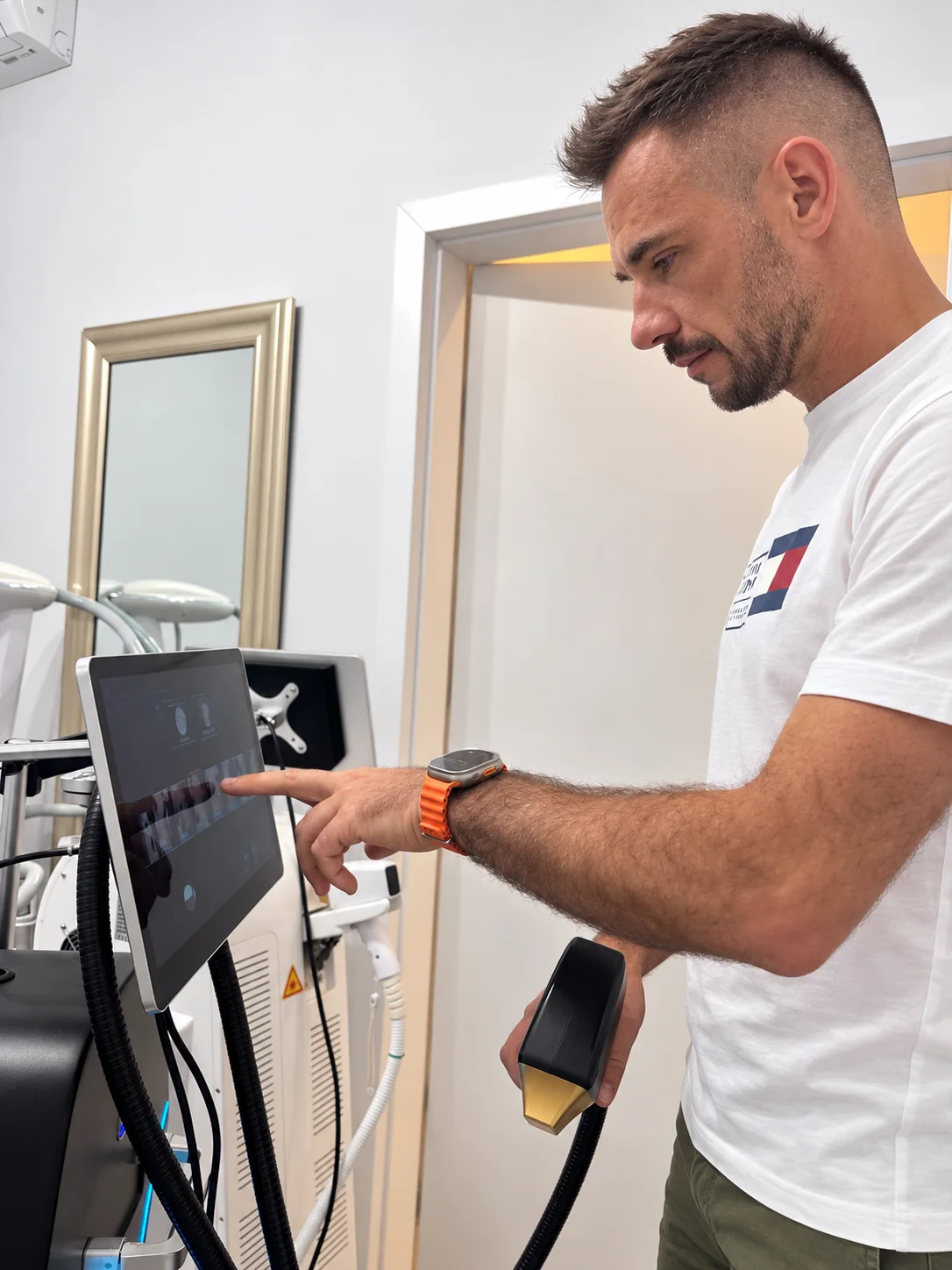
Laser Tech Service carried out hair removal laser servicing. The case includes a photograph of work at the control panel and handpiece. We confirm maintenance, but do not claim that water, pump or filters were replaced during that visit.
The photograph documents work at the control panel and handpiece. Operating and maintenance procedures must follow the individual device’s instructions.
What should you remember before the next working day?
Perform operator checks as instructed, observe maintenance dates and do not ignore leaks or alarms. If irregularities occur, stop use according to the instructions and report the problem. Give the laser service team the model, symptoms and maintenance history. This is a better starting point than selecting fluid yourself or replacing parts experimentally.
If the problem concerns the handpiece contact surface, also read how a Peltier module works and why a handpiece does not cool. Liquid circuit faults and TEC damage must be distinguished during diagnostics.
Need equipment servicing?
Send Laser Tech Service the device model and a problem description to agree the next steps.