A large device, a small component
In professional aesthetic equipment, attention usually focuses on expensive components: electronics, pumps, sensors, modules and handpieces. When something stops working, these are easily suspected. Yet the operation of an entire system may depend on a wire whose value is small compared with the device’s price.
A wire need not look impressive to perform an important role. If power does not reach an assembly, it cannot do its job. The rest of the device may behave entirely normally. This apparent contradiction can make such faults misleading.
The screen works. Why does the handpiece not?
Switching on a device confirms only that at least some of its systems have started. It does not prove that every load has a working supply circuit. The screen and some functions may operate while a particular handpiece remains without the power it needs.
An error message may not appear either. This depends on how the particular circuit is designed and monitored. The absence of a message does not replace diagnostics, just as an illuminated screen does not establish that the whole device works correctly.
“The wire broke inside” — what does that mean?
From the outside, we mainly see insulation. This is a covering; the conductor lies beneath it. Internal conductors can be damaged while the cable surface still appears normal. The problem may develop at a point of repeated bending or near a connection.
Damage does not always cause a constant symptom. In one cable position, contact may briefly return and disappear when the position changes. The device then works intermittently. This is a general example of an intermittent fault, not a confirmed description of the device at studio Tiamo.
This is why inspecting the insulation alone cannot settle the diagnosis. Hidden damage may lie in a section concealed within the handpiece’s cable route during normal use.
No vacuum is a symptom, not a diagnosis
When a handpiece produces no vacuum, the pump or vacuum module is often the first suspect. These are possible causes, but not the only ones. A supply fault, damaged contact, connector or wire can also stop the system.
Replacing a pump will not repair a broken wire. Servicing should therefore trace the circuit and establish where it ceases to perform its function. The aim is to find the cause, rather than replace successive parts in the hope that one is responsible.
This also explains the value of a precise symptom description. Knowing which function fails and when helps diagnostics begin. Naming an apparently faulty module does not yet provide an answer.
An example from Wrocław: Beauty Planet 3D Contour
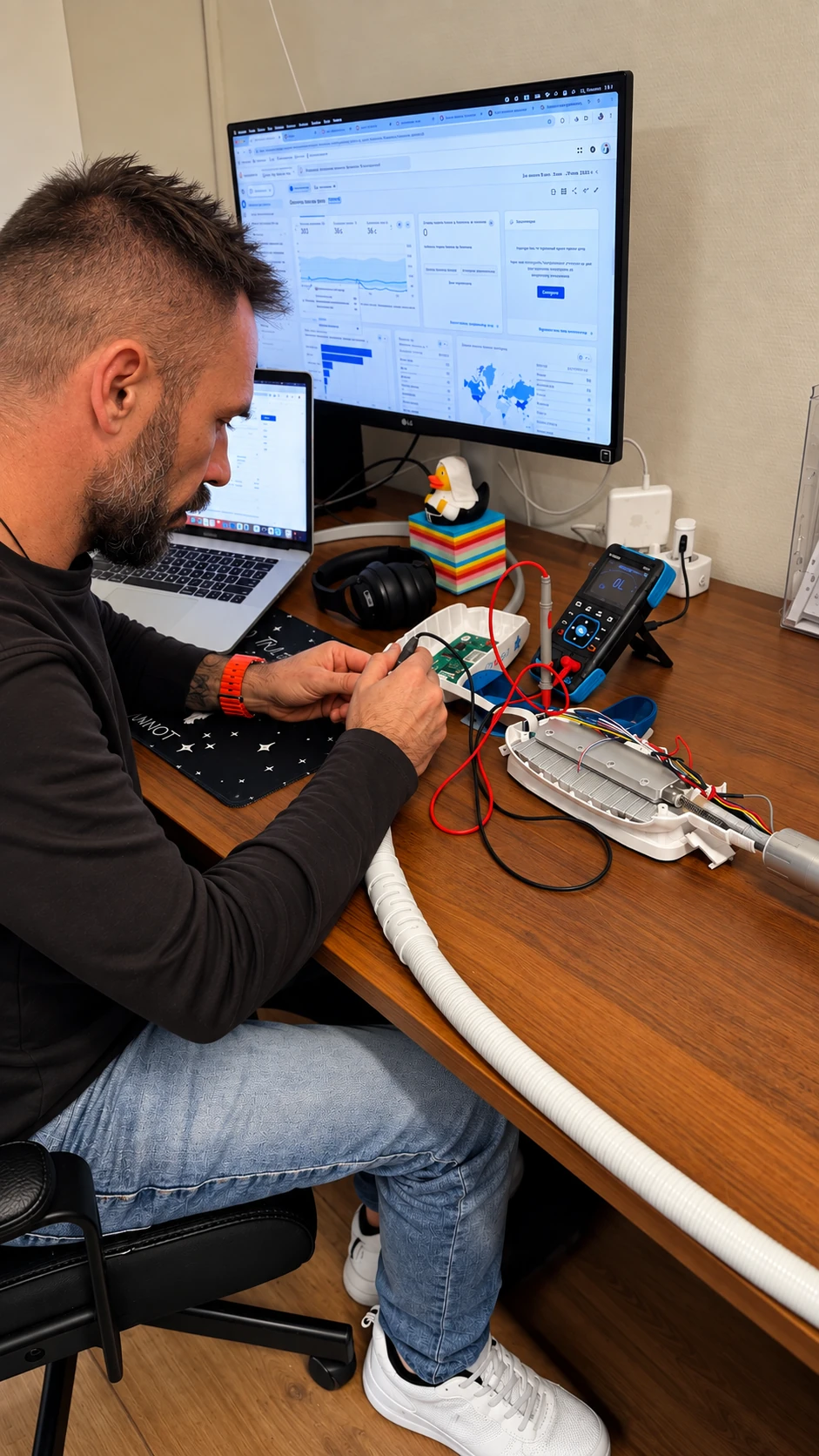
At studio Tiamo, the Beauty Planet 3D Contour switched on, but the handpiece vacuum did not work. Laser Tech Service diagnostics identified damage to a power wire inside the handpiece cable route.
After checking the circuit and locating the fault, we dismantled the necessary parts, removed the damaged wire and fitted a new one. We then checked the connections, reassembled the device and tested vacuum operation. The details are described in the Beauty Planet 3D Contour cable replacement case study from Wrocław.
A small part does not always mean a small job
A wire concealed within professional equipment or a handpiece is not the same as a cable that simply unplugs from a socket. Reaching it may require safe partial dismantling, exposing the cable route and finding the particular section.
The damaged component must then be removed carefully, a suitable wire fitted, connections restored and the assembly rebuilt. The work does not end there. The repaired system needs operational checks under appropriate conditions, under load where necessary, rather than merely checking that the screen still switches on.
The part’s price therefore does not describe the full scope of servicing. Fault location, access and checking the outcome also matter. A small wire may require just as much care as a much larger component.
What should you remember?
Intact insulation does not guarantee an intact conductor, and a working screen does not guarantee power to every function. Establishing the link between the symptom and its specific cause is essential.
The Beauty Planet 3D Contour case shows why diagnostics comes first. The problem appeared to be a vacuum fault, but originated in a wire in its supply circuit. After repair, we checked vacuum — the function that had previously failed.
If your device behaves similarly, describe the symptoms and model when contacting Laser Tech Service. This helps determine the next diagnostic steps without blaming a particular module on first impressions alone.
See the work carried out
From circuit checks to vacuum testing — a separate account of the Beauty Planet 3D Contour repair for studio Tiamo.