In Poznań, a laser owner attempted to resolve a minor problem by replacing a handpiece seal. The part itself was small and relatively inexpensive. However, it was installed incorrectly. The assembly lost its watertightness, allowing water or coolant into the diode module and damaging it.
At Laser Tech Service, we removed the damaged module, installed a new one and replaced and correctly seated the seal. The owner paid for the new module: this particular case was not covered by warranty because the failure followed the owner’s intervention. An attempt to save money on a minor task resulted in a much larger expense.
What does a seal actually protect in a laser device?
In a liquid-cooled assembly, a seal closes the joint between mating components. It helps keep fluid within its intended circuit and away from areas it should not enter. An inconspicuous laser handpiece seal therefore protects much more expensive parts.
In this repair, the problem did not begin with spontaneous diode failure. The joint lost its seal first; flooding and module damage followed. This sequence explains why replacing the expensive component without fixing the leak would not resolve the problem.
Why do position, seating and compression matter?
A seal works correctly only when it is suitable for the joint and properly positioned. Displacement, folding or uneven compression can leave a path for liquid. A tightened housing does not prove that the seal contacts correctly around its entire perimeter.
The importance of controlled compression is also explained by Parker in its sealing materials. This is a general joint design principle, not identification of the seal manufacturer in this device. Incorrect installation was confirmed in our case; we do not attribute an undocumented type of deformation to it.
A small leak may not be visible outside
Liquid may enter the handpiece through a leaking joint instead of immediately forming a puddle beneath the device. No water on the housing does not rule out an internal problem. Even a small leak requires assessment, particularly after work on the cooling system.
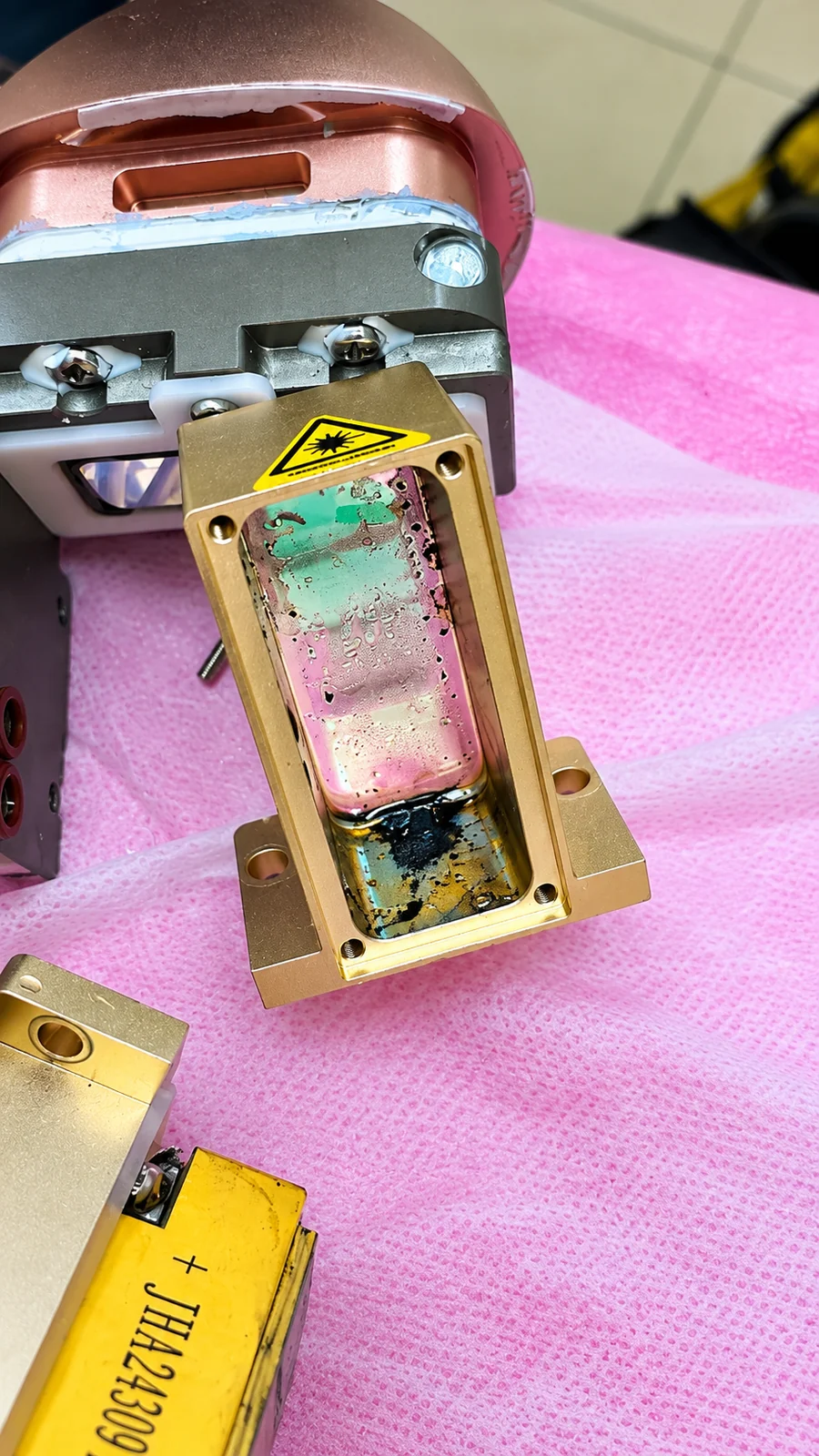
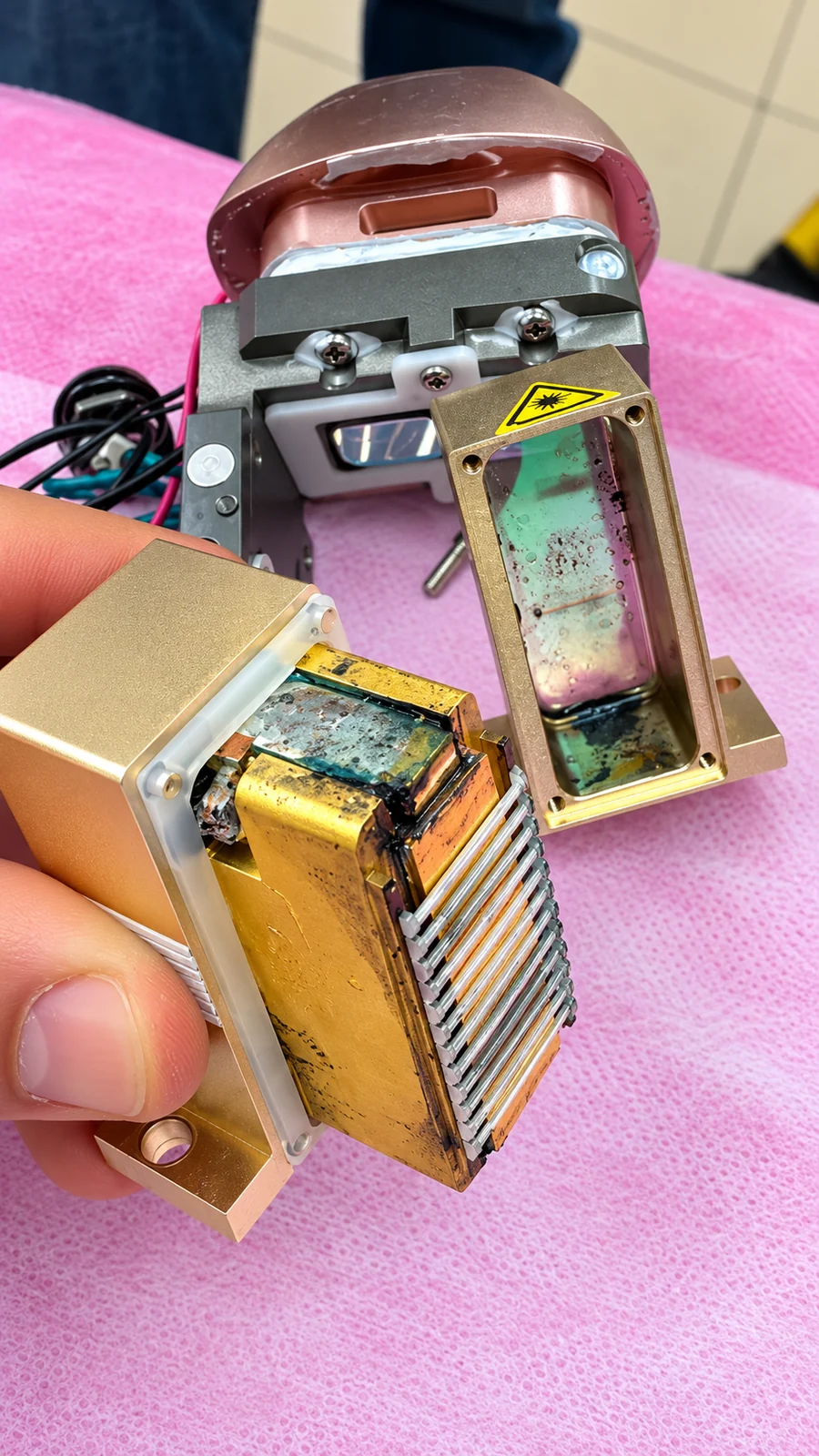
The Poznań photographs show droplets, deposits and contamination in the opened assembly. They document the effects of liquid ingress; they do not establish the amount of fluid or the duration of the leak from photographs alone.
Why is liquid dangerous for diodes and electronics?
Cooling fluid should not be present on sensitive electrical and optical components. Moisture and contamination can promote corrosion, compromise electrical insulation and leave deposits. A visible droplet drying out does not mean that a component has recovered.
Water and contamination on diode components and optics are also identified as reliability risks in nLIGHT’s technical material on diode lasers. This does not mean that nLIGHT manufactured the repaired device. In the Poznań case, the damaged module required replacement.
Why is diode module replacement so expensive?
A diode module is the laser’s light source, not a simple housing part. It combines emitting components with a structure providing power connections and heat removal. Manufacturers offer different diode arrangements and cooling solutions, as shown in the Coherent diode stack overview. The particular component must be matched to the device.
Diode laser repair may require an expensive module replacement even when a small seal caused the problem. In a hair removal laser, this is one of the most costly components. What is commonly called laser diode replacement may actually involve replacing the entire module. That was the scope required in this case. We do not give module or seal prices because no confirmed quotation is available for publication.
The savings calculation: a seal versus a new module
The key point is the difference in scale: a relatively inexpensive seal protects a component worth many times more. The owner hoped to avoid professional servicing costs but ultimately had to pay for a new module and repair of the leak’s cause. In this case, saving on servicing did not reduce the total bill.
The non-warranty repair information concerns this specific event. It does not describe every manufacturer’s warranty terms. The practical lesson remains the same: compare the cost of professional seal replacement with the consequences of losing watertightness.
Why is simply reassembling the handpiece not enough?
Professional laser servicing covers not only replacing a damaged part but also assessing the cause. For a leaking handpiece, the seal and cooling system are critical. A working screen or closed housing does not prove watertightness. After cooling system work, the service team should check:
- correct assembly of the handpiece components;
- seal condition and correct seating;
- watertightness of the joints worked on;
- correct coolant circulation;
- absence of leaks after servicing.
The checks and methods must match the individual device’s design and documentation. This list explains the purpose of servicing; it is not a dismantling guide. Check results should not be replaced by a statement that the device switches on.
When should the device be switched off immediately?
- When water or moisture is visible in the handpiece.
- When an unexplained fall in fluid level suggests a leak.
- When leak traces appear on the device or its connections.
- When cooling behaviour changes unexpectedly.
- When unusual symptoms follow the owner’s intervention.
Stop treatments, switch off the device and contact the service team. Do not keep working to see whether the problem disappears. Describe the symptoms and any previous intervention to the service team — this helps plan diagnostics without guessing the cause.
A small seal carries a significant responsibility
Inexpensive seal → incorrect installation → loss of watertightness → water in the module → diode damage → expensive replacement. That was the sequence in this case. Professional seal replacement costs far less than replacing a damaged diode module. Saving on a small seal can end in repairing one of the device’s most expensive assemblies.
See the actual repair case from Poznań
An incorrectly fitted seal allowed liquid into the module. See the damage and the repair work carried out in Poznań.