A small component with an important job
When choosing a laser hair removal system, clinic owners often focus on output power, wavelengths, treatment performance and handpiece durability.
However, the cooling filter is another component that deserves attention.
Its purpose is to retain certain contaminants circulating in the cooling medium.
Although relatively simple, this component can influence the reliability of the cooling circuit.
How does diode laser cooling work?
Laser diode modules generate heat during operation.
Only part of the supplied electrical energy becomes useful optical output. A substantial proportion is released as heat.
In liquid-cooled systems, a pump circulates coolant through designated components and transfers heat towards a heat exchanger.
Some systems contain narrow cooling channels that require suitable coolant quality and adequate circulation.
What happens when a filter becomes contaminated?
Particles, corrosion products and other impurities can accumulate inside the filter.
As contamination increases, hydraulic resistance may rise.
Depending on the system design, coolant flow can decrease, reducing cooling efficiency and increasing the risk of component overheating.
Inadequate cooling may eventually contribute to equipment shutdowns or premature component failure.
However, discoloration alone does not prove that a filter is completely blocked. Flow restrictions should be evaluated through appropriate diagnostics.
Can a blocked filter damage the pump?
A contaminated filter can alter the pump's operating conditions.
The consequences depend on the pump type and cooling circuit design.
Potential problems include unstable circulation, cavitation and unfavorable operating conditions.
It would be inaccurate to assume that every pump automatically draws more power when a filter becomes restricted.
Warning signs
Operators should pay attention to temperature alarms, insufficient-flow warnings, unusual pump noises, coolant contamination and visible leaks.
Some laser systems automatically disable emission when cooling conditions fall outside their operating limits.
Safety interlocks must never be bypassed.
A real maintenance example from Wrocław
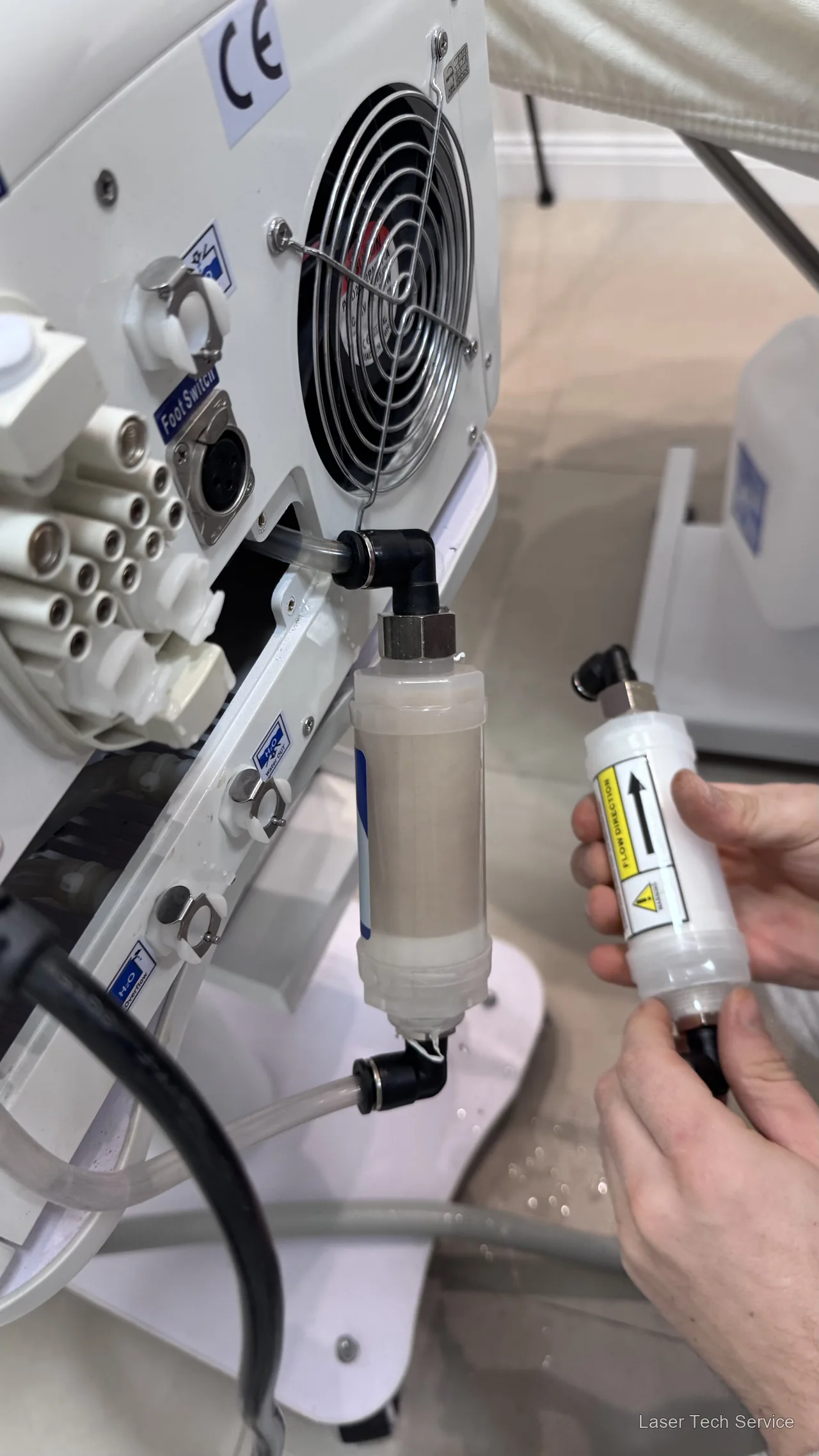
During an Aragon / Beauty Planet diode laser maintenance visit in Wrocław, Laser Tech Service technicians replaced a visibly discolored cooling filter.
The cooling water was also renewed and relevant connections were inspected.
This demonstrates the value of preventive maintenance even when equipment remains operational.
How often should cooling filters be replaced?
There is no universal replacement interval applicable to all diode lasers.
The correct schedule depends on manufacturer instructions, equipment design, filter specifications, coolant quality and usage.
Some systems may require replacement every few months, but the actual interval must follow the specific manufacturer's requirements.
Should clinic staff replace filters themselves?
Routine visual inspections may be performed by trained operators where permitted by the manufacturer.
Opening the hydraulic circuit, replacing fittings, draining coolant and removing trapped air should be handled by appropriately qualified personnel.
Incorrect maintenance may cause leaks or inadequate cooling.
Conclusion
Regular cooling filter inspection and timely replacement help maintain reliable diode laser operation.
Preventive servicing can reduce the risk of overheating, unexpected downtime and expensive repairs.
Laser Tech Service provides professional maintenance and repairs for aesthetic laser equipment throughout Poland.
Related articles and services
- Laser equipment cooling system repair
- Aragon Diode Laser Maintenance in Wrocław — Cooling Filter and Water Replacement
- Diode Laser Maintenance Checklist: Cooling System Inspection
- What Water Should You Use in a Diode Laser Cooling System?
- Diode laser diagnostics
- Aesthetic equipment cleaning and maintenance
Does your equipment need servicing?
Send the device model, photos and a short description of the problem to discuss the next steps.