Above all, the device needs to work
For a clinic owner, the priority is straightforward: equipment must operate. When a laser, RF, HIFU or another aesthetic device stops working, scheduling, clients and income are affected.
The priority is to establish promptly what has actually failed. This does not always require a whole module, handpiece or main board replacement. Sometimes a much smaller part can be repaired or replaced without unnecessary expense.
That is why, at Laser Tech Service, we begin with diagnostics. We find the cause first and then decide what actually needs doing.
It is often better to visit the device than send it away
Professional aesthetic equipment can be large, heavy and delicate. Preparing it for transport, protecting it, shipping it and reinstalling it in the clinic take time and introduce additional risks.
In many cases, an on-site service visit is more practical. Where the fault permits, diagnostics and repair can be completed on site without taking the device out of service for several days.
We serve clients in Wrocław and throughout Poland. Depending on the fault, we determine whether on-site repair or delivery of a particular component to our service centre is more appropriate.
A repair warranty matters
A professional repair provider should take responsibility for their work.
After servicing, the client should know what was repaired, which components were replaced and the applicable warranty terms.
This is particularly important for commercially used equipment. A clinic needs to know whom to contact if a problem occurs after repair.
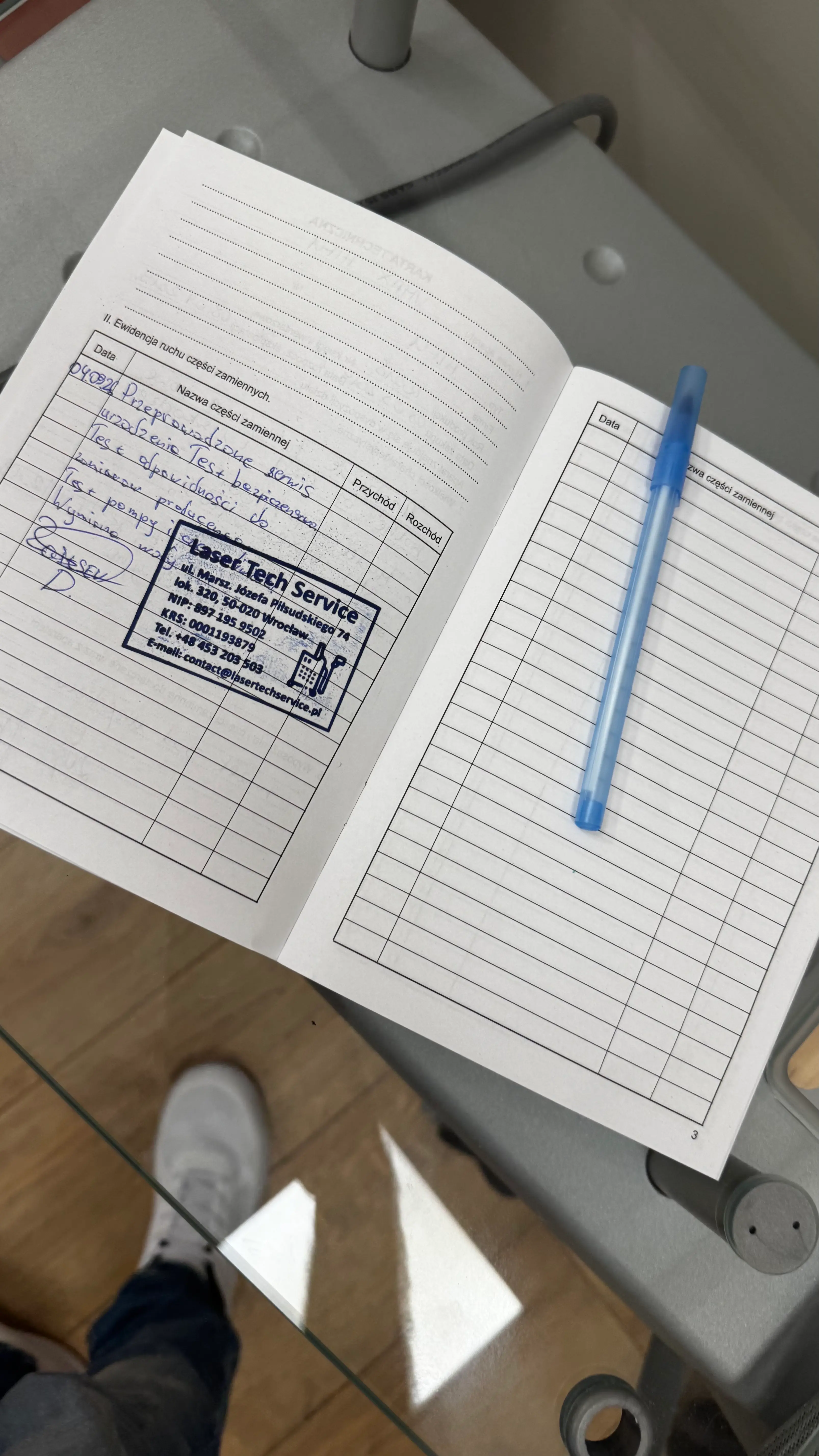
Service documentation is more than paperwork
After several years of use, it is easy to forget when a repair took place, which part was replaced or what caused an earlier failure.
Service documentation preserves the device’s history. During subsequent diagnostics, the technician can see what work has already been done and which components were repaired or replaced.
This can often help identify a new problem more quickly and avoid repeating the same diagnostic work.
Service history adds value to equipment
Aesthetic equipment does not always remain in one clinic throughout its working life. An owner may purchase a newer model, change technology or sell used equipment.
A documented service history then becomes important. A potential buyer can see that the device has been regularly checked, repaired and maintained professionally.
This differs substantially from selling a device whose technical history is unknown.
A service label says more than you might think
After servicing, it is useful to label the device with who performed the work and when.
A small service label helps the owner remember the maintenance and lets a subsequent technician quickly identify who previously worked on the equipment.
It is a simple feature, but together with documentation it creates a clear technical history.
Regular servicing usually costs less than a major failure
Many technical problems develop gradually. They begin with minor symptoms: unusual sounds, weaker cooling, reduced power, screen errors, vacuum problems or unstable handpiece operation.
Ignoring these signs can lead to damage to further components.
Regular inspection, cooling system cleaning, electrical connection checks and component assessment can identify a problem before a small fault becomes an expensive failure.
Professional servicing does not mean replacing half the device
Replacing successive modules without precise diagnostics is one of the most expensive repair approaches.
A device not working does not automatically require replacement of the entire board, complete handpiece or whole cooling system.
Good servicing should establish the specific cause. Where a component can be safely repaired or refurbished, or only the faulty part replaced, this is often a much more sensible option for the owner.
We show examples in our Case studies section, where we publish actual equipment repair cases from our service work.
Knowing whom to call matters most
Equipment failure always happens at an inconvenient moment, often when treatment schedules are full and clients already booked.
It is therefore worth having the details of a service provider familiar with this equipment, able to diagnose it promptly and explain the repair options clearly.
If a laser or other aesthetic device is not working correctly, there is no need to assume the worst immediately. Prompt diagnostics can sometimes resolve the issue before a more serious failure develops.
A problem with your equipment?
Describe the fault, send a photograph or video and contact us. We will assess where diagnostics should begin.
Wrocław, 2026