What exactly is HIFU?
The term HIFU stands for High-Intensity Focused Ultrasound, describing ultrasound energy focused at high intensity.
The key word is focused. HIFU does not apply ultrasound energy only at the surface. The transducer’s design focuses the waves within a specific area at a designed depth.
A simplified analogy is a lens focusing light. The rays pass through space, but their greatest concentration occurs at a particular point.
In HIFU, a similar principle applies to ultrasound waves. Energy concentrates in a small focal zone.
HIFU does not simply mean “powerful ultrasound”. Its defining feature is controlled focusing of energy at a specified depth.
How does HIFU work?
A HIFU handpiece contains a transducer that generates ultrasound waves.
The transducer design causes the waves to converge within a particular zone. Energy concentration is greatest there.
In aesthetic systems, energy at the focus produces a local thermal effect. Small areas of action form at the selected depth, while tissues along the wave path are not where energy is most concentrated.
This is why device parameters, handpiece design and a correctly selected cartridge matter so much in HIFU.
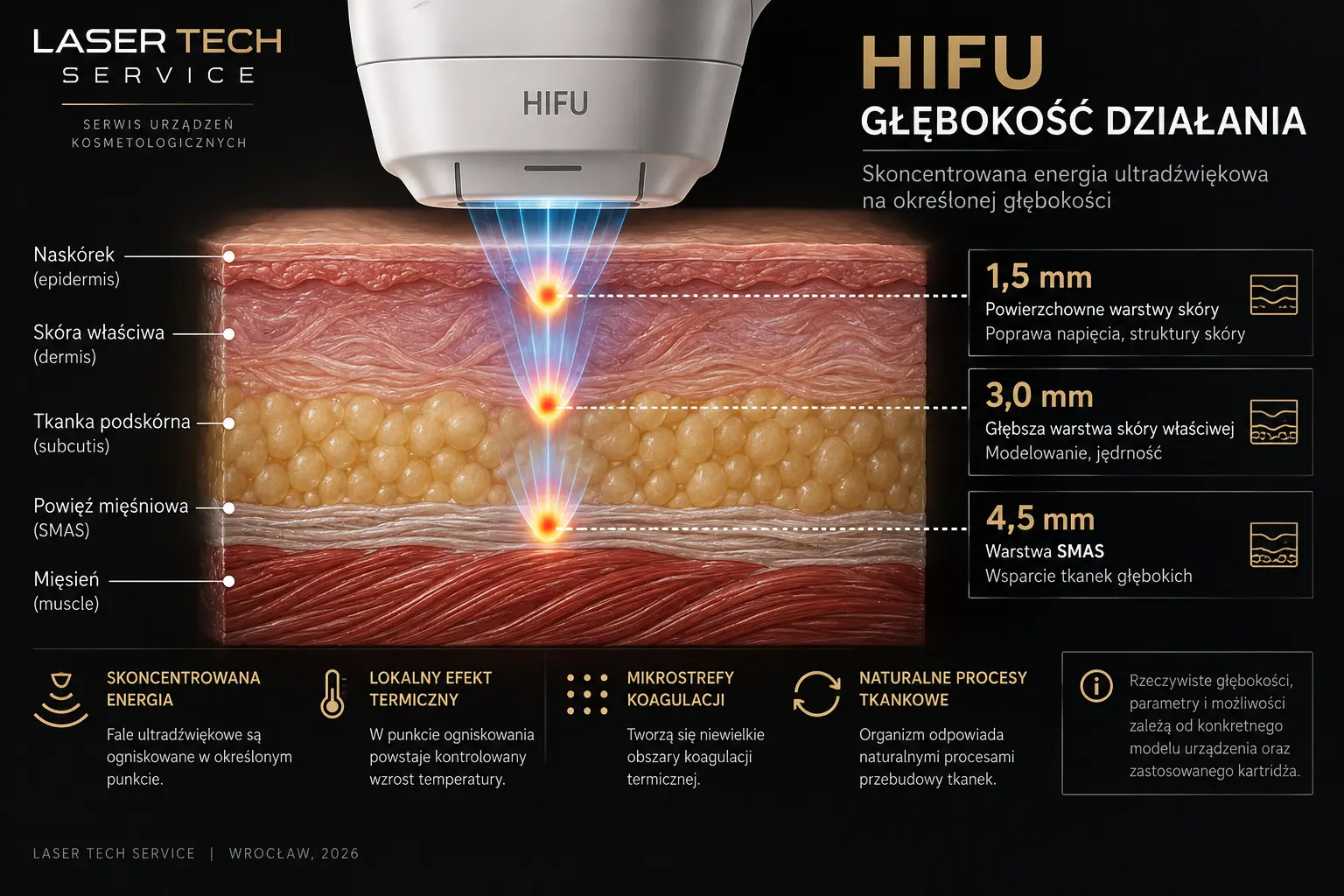
What do 1.5 mm, 3.0 mm and 4.5 mm mean in HIFU?
HIFU devices frequently carry the markings: 1.5 mm, 3.0 mm and 4.5 mm.
These are not needle lengths or an indication of how deeply the operator physically presses the handpiece.
The value refers to the designed energy focal depth of the particular transducer or cartridge.
- 1.5 mm – one of the more superficial depths found in aesthetic devices,
- 3.0 mm – a deeper plane of action,
- 4.5 mm – a deeper plane still, associated in aesthetic systems with structures including fibromuscular layers.
This does not mean that every HIFU device has only these three values.
Other depths may be used depending on the design and intended purpose of the particular system.
HIFU and conventional ultrasound are not the same
Two devices using ultrasound do not necessarily operate in the same way.
HIFU’s distinguishing feature is the concentration of ultrasound energy at a defined focus .
In conventional ultrasound devices, energy may propagate very differently.
HIFU should therefore not be regarded simply as a more powerful version of a conventional ultrasound handpiece. It is a distinct technology using a different energy delivery method.
What is HIFU used for in aesthetics?
In equipment intended for aesthetic applications, HIFU provides controlled effects in selected tissue layers.
Depending on the device, transducer, depth and manufacturer’s recommendations, HIFU systems may be intended for facial or body treatments.
These devices are used in procedures aimed at improving skin firmness, treating selected facial areas and contouring particular body areas.
However, not every HIFU device has identical applications.
Specifications, frequency, energy, working depths and transducer design can vary substantially by manufacturer and model.
What makes up a HIFU device?
To the operator, it may look relatively simple: a housing with a screen, a cable, a handpiece and a replaceable cartridge.
Technically, however, it is a much more complex system.
Depending on the model, it may contain:
- a power supply,
- control electronics,
- a control panel or touchscreen,
- modules communicating with the handpiece,
- a treatment handpiece,
- an ultrasound transducer,
- replaceable cartridges,
- cables and connectors,
- additional systems specific to the model’s design.
Why is the HIFU handpiece so important?
The handpiece is a key part of the system because it delivers energy to the treatment area.
It contains components that generate and appropriately direct ultrasound energy.
If the handpiece malfunctions, the device may still start and the screen may work normally, yet correct treatment may be impossible.
The observation “the device switches on” should therefore not be equated with full system functionality.
What exactly is a HIFU cartridge?
A cartridge is more than a plastic attachment changed during use.
Its design is associated with operating parameters and a particular focal depth.
Cartridge construction, available pulse count, device identification and interaction with the handpiece can differ by manufacturer.
Cartridges for different HIFU devices should therefore not automatically be assumed compatible.
What can go wrong in a HIFU device?
As with other professional aesthetic equipment, a HIFU fault can affect various components.
An operator may notice, for example:
- incorrect handpiece operation,
- cartridge recognition problems,
- error messages,
- device start-up problems,
- incorrect communication between modules,
- unstable device operation,
- power supply problems.
Some models also have additional systems requiring periodic inspection and maintenance.
It is important not to diagnose the device from a single symptom alone.
A handpiece not working does not automatically mean a new one must be purchased. The actual location of the problem must first be established.
Diagnostics before replacing parts
Professional aesthetic equipment is a system of interacting components.
One symptom can have several causes.
Correct diagnostics should therefore answer the central question: which component is actually faulty?
Only then can a decision be made about repair, refurbishment, replacement or another course of action.
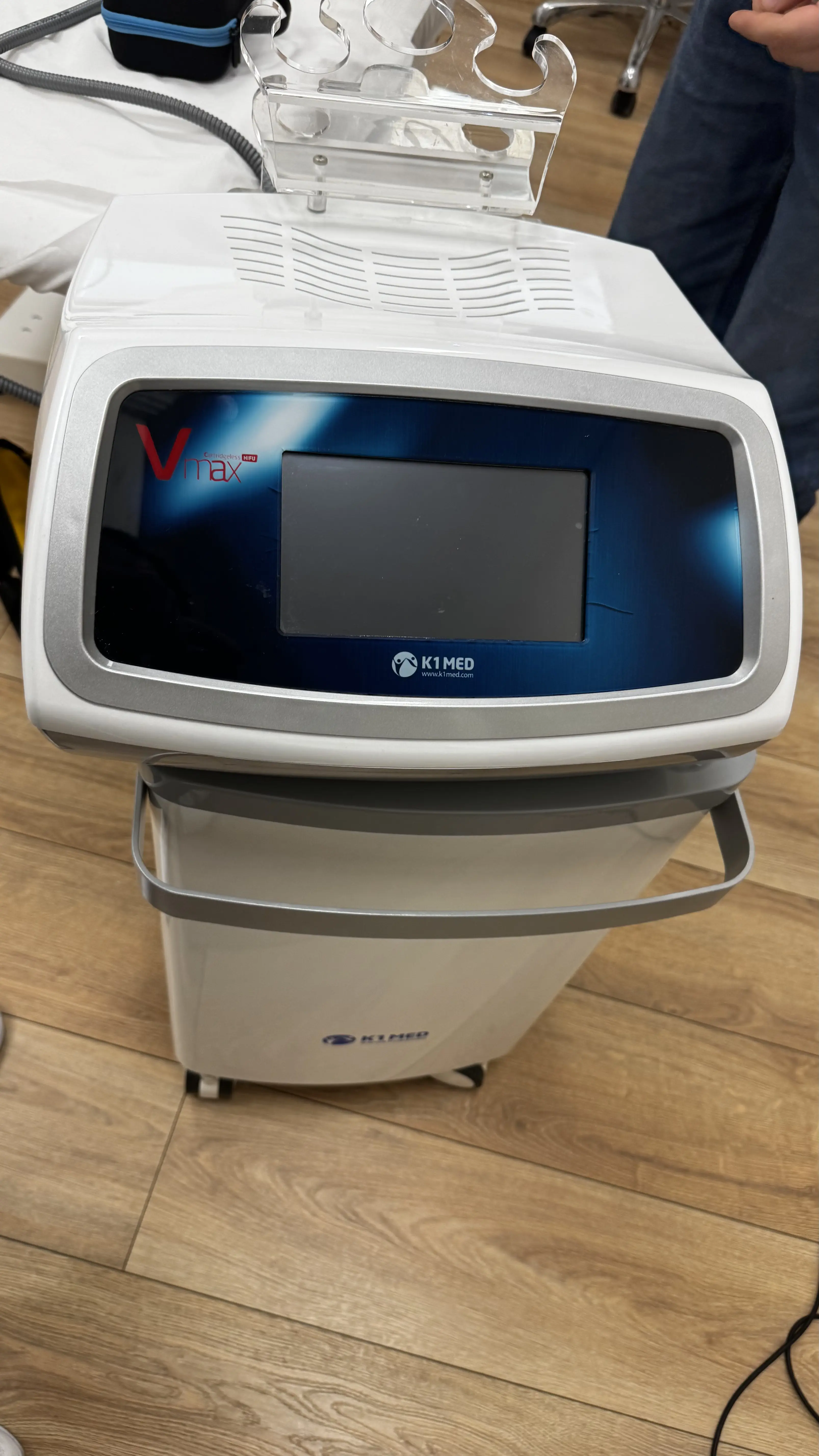
An actual example – HIFU KIMED K1-W1601
One HIFU device serviced by Laser Tech Service was the KIMED K1-W1601.
We carried out the service directly at the client’s premises in Görlitz, Germany.
The device had a non-functioning HIFU handpiece.
We diagnosed and repaired the handpiece and also maintained the device.
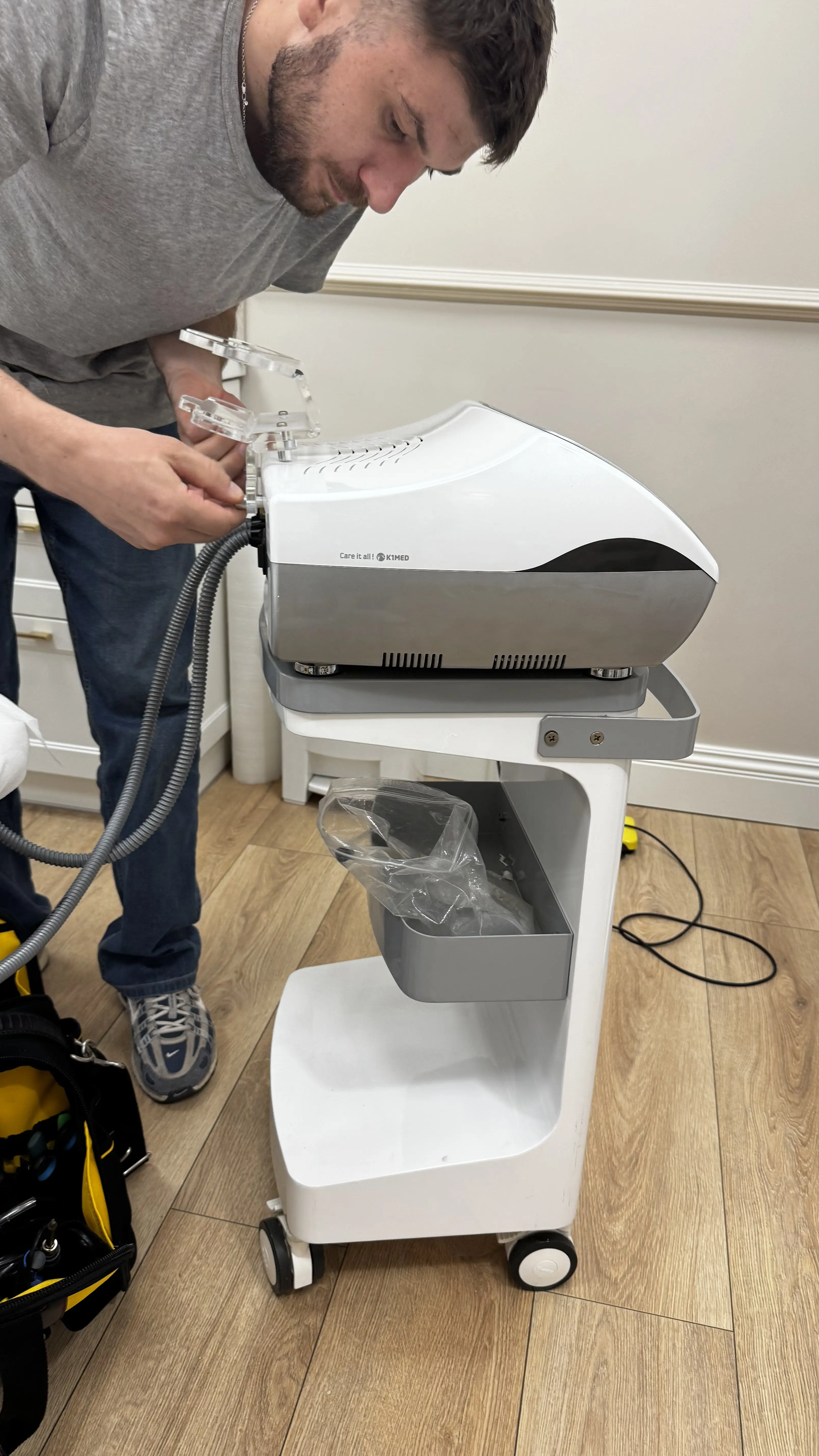
On this particular model, we also performed water circuit cleaning and checked the device after completing the work.
This illustrates why a problem with one function of professional aesthetic equipment should first be diagnosed properly.
The full case study, including photographs and videos, is available here:
HIFU KIMED K1-W1601 servicing – handpiece repair and maintenance →
Does every HIFU fault require transporting the whole device?
Not necessarily.
The approach depends on the symptoms, the individual device’s design and the nature of the fault.
In some cases, a conversation with a technician, photographs, a video showing the problem or initial diagnostics can considerably narrow down the possible cause.
Before arranging transport for a large, heavy device, contact the service team and describe the problem carefully.
HIFU from a clinic owner’s perspective
For a clinic owner, a HIFU device is primarily a working tool.
If it stops working, the consequences extend beyond the technical fault itself.
A breakdown may mean:
- rescheduling appointments,
- suspending some services,
- losing planned working time,
- equipment transport costs,
- purchasing parts or arranging repairs.
When buying a device, it is therefore worth considering more than price and marketing specifications.
Also important is the availability of servicing, parts, cartridges and technical support .
Is used HIFU equipment worth considering?
A used HIFU device may be an alternative to new equipment, but its technical condition should be checked thoroughly.
The fact that it starts and displays a menu does not provide a complete picture of system condition.
Points to consider include:
- handpiece condition,
- the condition of available cartridges,
- correct communication between device and handpiece,
- operation of all functions,
- cable and connector condition,
- previous repair history,
- overall technical condition.
With professional equipment, service history can be much more informative than the appearance of the housing.
HIFU, RF and laser — three different technologies
HIFU is sometimes mentioned alongside RF and laser technologies, but technically these deliver energy in very different ways.
- HIFU uses focused ultrasound waves.
- RF uses radiofrequency electromagnetic energy.
- laser uses optical radiation at a particular wavelength.
Their use in similar aesthetic applications does not mean that the devices operate on the same principle.
Are all HIFU devices the same?
No.
Many devices with differing designs and build quality are sold under the HIFU name.
Differences may include:
- transducer type,
- available depths,
- operating frequency,
- energy adjustment range,
- handpiece design,
- cartridge type,
- cooling or circulation system,
- control electronics,
- device software.
The specifications of one model should therefore not automatically be attributed to every HIFU device.
Why does regular servicing matter?
A HIFU device in a clinic is regularly switched on, moved and handled by operators.
Cables, connectors, handpieces and other components are therefore subject to use and wear.
Periodic technical checks can reveal problems before they take the device completely out of service.
The inspection scope must, of course, suit the particular model and design.
Frequently asked questions about HIFU
What does HIFU stand for?
HIFU stands for High-Intensity Focused Ultrasound, describing ultrasound focused at high intensity.
What does 4.5 mm mean in HIFU?
It refers to the designed energy focal depth of the particular transducer or cartridge.
Are HIFU and aesthetic ultrasound the same?
No. HIFU’s key feature is concentrating ultrasound energy within a defined area.
Can a HIFU handpiece be repaired?
This depends on the handpiece design and fault. In our KIMED K1-W1601 case, the faulty handpiece was diagnosed and repaired.
Does a non-functioning handpiece require a new one?
Not always. The actual cause must be established before deciding on replacement.
Does Laser Tech Service repair HIFU devices?
Yes. We provide diagnostics, repair and maintenance of professional aesthetic equipment, including HIFU devices.
Summary
HIFU is a technology using focused ultrasound energy with a focal zone at a specified depth.
This is why devices have different handpieces and cartridges labelled, for example, 1.5 mm, 3.0 mm or 4.5 mm.
For a clinic, however, treatment capabilities are not the only consideration.
Technical condition, parts availability, working handpieces and cartridges, and access to professional diagnostics when problems arise are equally important.
When a fault occurs, replacing the most expensive component should not be the immediate response.
The best first step is identifying the actual cause.
Having a problem with a HIFU device?
Provide the manufacturer and model, describe the symptoms and send photographs or a video. We will assess where diagnostics should begin and whether the whole device needs transporting.